A shared mailbox is not a shared inbox
What breaks
A shared mailbox works perfectly with one person. Add a second and three failures appear immediately.
Nobody owns anything. Everyone assumes somebody else has it. The oldest message in a shared mailbox is almost always one that everyone saw and everyone skipped.
Duplicate replies. Two people answer the same customer, slightly differently. The customer now has two answers and less confidence than before they asked.
No history that survives. Somebody rings about an email thread. Whoever picks up cannot find it, because it is in a mailbox, filed by whoever last touched it, if at all.
What a shared inbox adds
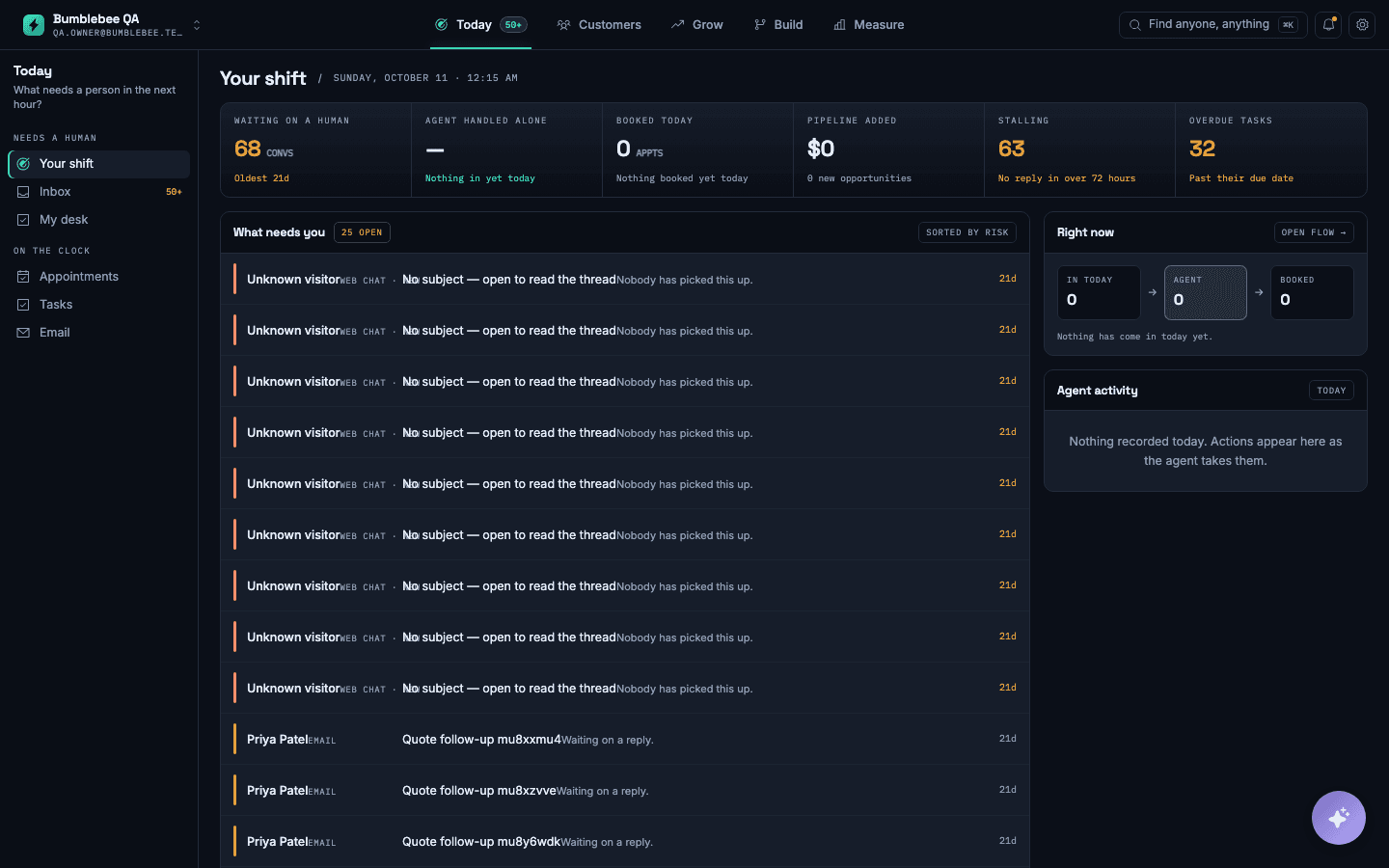
Assignment. Every conversation has exactly one owner, visibly. Unassigned is itself a state you can see and work through.
One thread per person, not per channel. The email, the text and the phone call from the same customer are one conversation. Whoever picks it up sees all of it.
A clock. Time since last reply, visible, with a target. Not to pressure anyone — to make the thing that has been sitting for three days impossible to miss.
Internal notes. Context attached to the conversation rather than sent as a separate message that later gets forwarded to the customer by accident.
What it costs while it is still "working"
The failure is rarely dramatic. Nothing crashes. What happens is slower and harder to see:
- Enquiries answered a day late because nobody realised they were theirs.
- A customer told two different prices by two different people.
- A complaint handled twice, the second person unaware it was resolved.
- Someone leaving the business and taking the context of forty open threads
- with them.
None of these appear on any report. All of them cost customers.
Moving without losing the history
The usual objection is the archive. Years of correspondence sitting in a mailbox that nobody wants to lose.
In practice you do not need to move it. Keep the old mailbox readable, point new enquiries at the shared inbox, and let the history age out naturally. A fortnight in, nobody opens the old one except to search. Six months in, nobody opens it at all.
What matters is that from day one every *new* conversation has an owner and a clock.
The test
Ask: if the person who normally handles enquiries is off sick tomorrow, can somebody else pick up every open conversation and know exactly where each one got to?
With a shared mailbox the honest answer is no. That is the entire difference, and it is the reason the switch usually pays for itself in the first week somebody is unexpectedly away.