How to get more reviews without breaking the rules
Why most review requests fail
Asked too late. A week after the appointment the feeling has faded and the email is one of forty.
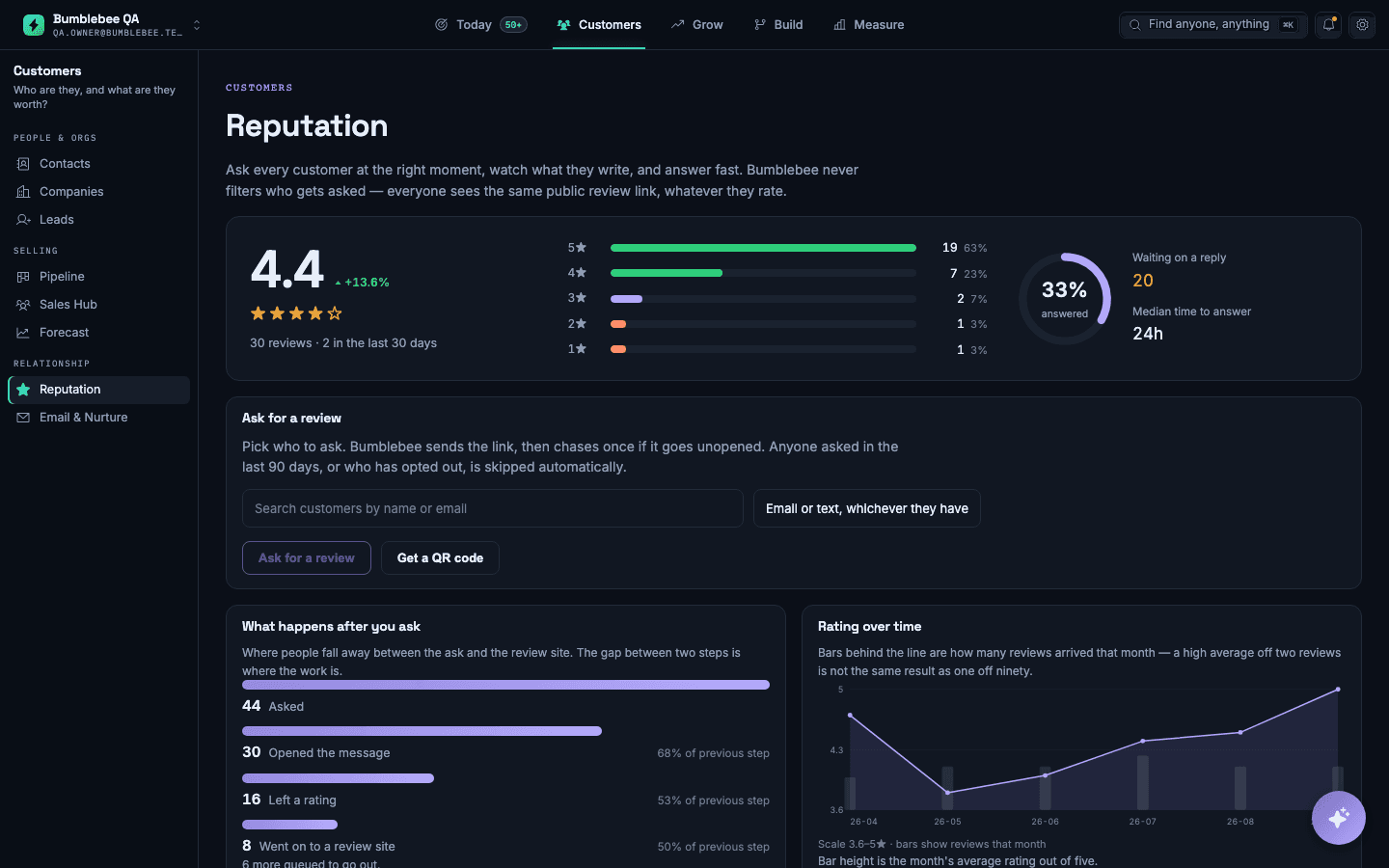
Too much friction. "Search for us on Google and leave a review" is three steps too many. Every step loses most of the people.
Asked of everyone. Including the person whose appointment overran by forty minutes. Ask them for feedback, certainly — just not publicly, and not first.
What works
Within a few hours. While they still remember it going well.
By the channel they already use. If everything has been by text, ask by text. An email to somebody who has never emailed you will not be seen.
One link, one tap. Straight to the review box.
Once, and then stop. A second ask is a nudge. A third is harassment and earns you the review you deserve.
What you must not do
Incentives. Discounts, prize draws, free anything in exchange for a review. Prohibited by most platforms, detectable, and the usual outcome is removal of every review you have — including the genuine ones.
Review gating. Asking how it went, then only sending the review link to people who said "great". Explicitly against Google's policy. It is also pointless: it produces a rating nobody believes, because a perfect five across three hundred reviews reads as fake to every customer looking at it.
Writing them yourself. Obvious, detectable, and fatal to trust when found.
When to ask, by trade
The right moment varies more than people expect.
Same-day services — a repair, a treatment, a visit. Ask within a few hours, while the relief is fresh.
Longer projects — a build, a course of treatment, anything over weeks. Ask at the first visible milestone rather than at the end, when the memory of the disruption is strongest.
Recurring customers. Ask once, early in the relationship. Asking a regular every visit is how a loyal customer becomes an irritated one.
Anything that went wrong and was fixed well. Counter-intuitively one of the best moments. A customer whose problem you solved properly is often more motivated than one who had an uneventful experience.
Handling a bad one
Reply the same day. Address the specific thing — this requires actually knowing what happened, which is why the review being matched to the visit matters. Offer to continue it privately, and mean it.
And remember who you are writing for. It is not the reviewer, who has decided. It is the hundred people who will read the exchange while choosing. A calm, specific reply to an angry review is worth more than the five-star above it.